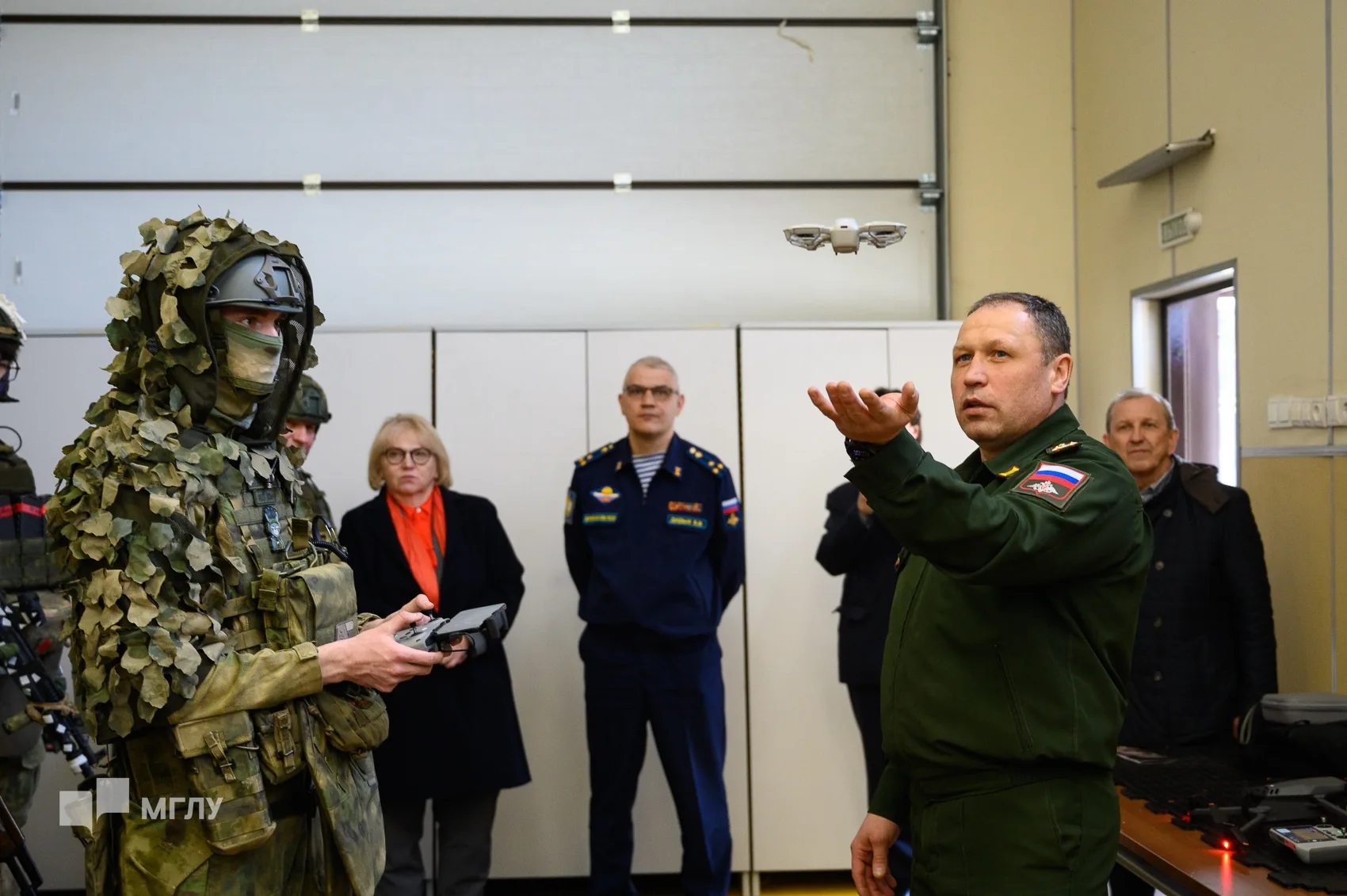
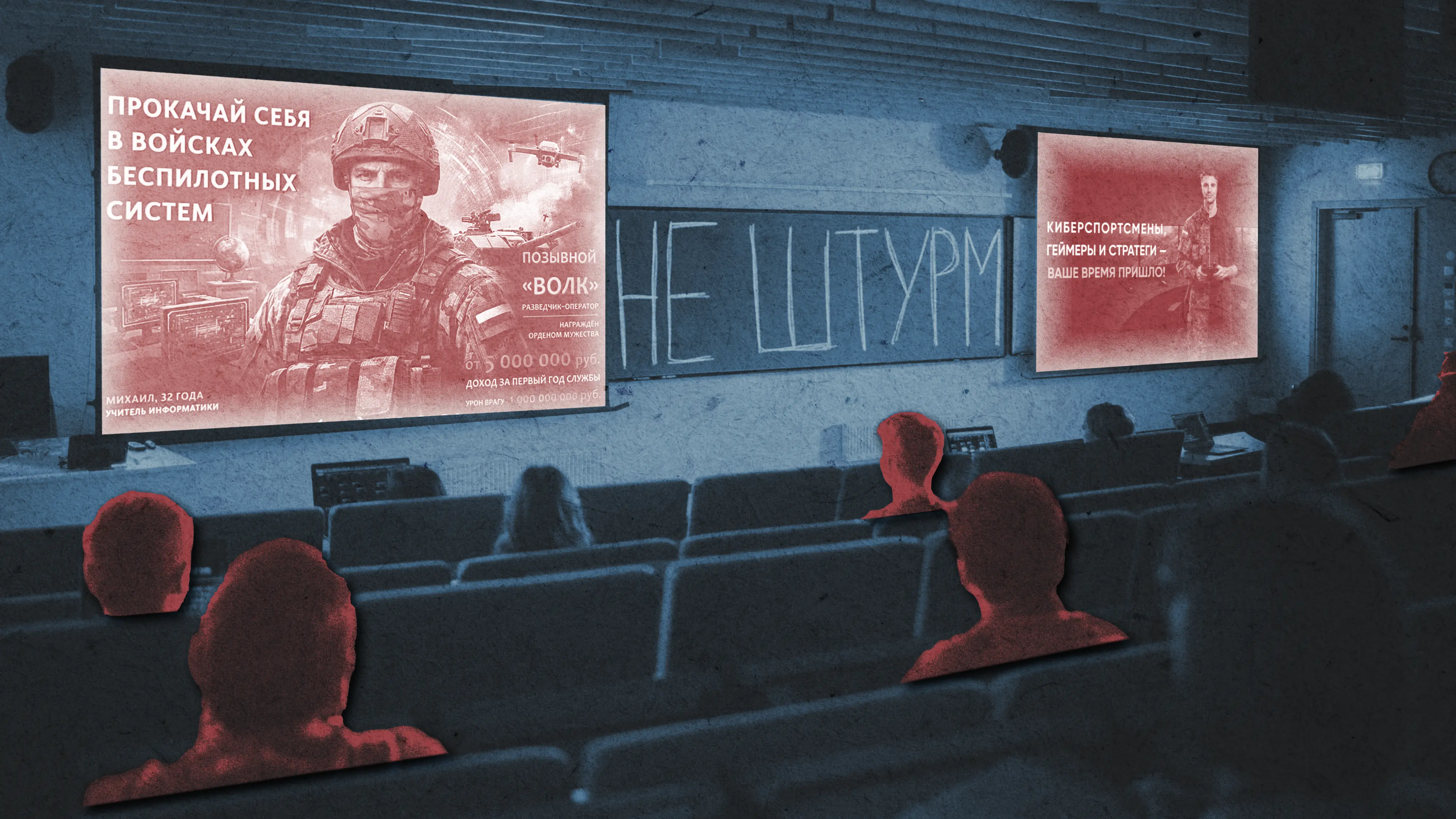
A large-scale campaign to recruit students for the front has been underway since February 2026. By early April, Groza had documented 269 educational institutions where students were being forced to enlist in the so-called drone forces. The real number is likely higher.
Groza, for Important Stories, reports on what educational institutions are doing to get students to sign contracts with the Ministry of Defense.
In March 2026, Groza readers reported that the administration of Far Eastern Federal University (FEFU) had shortened the retake period by almost a month and sent expulsion notices to some students with academic debts — even though they still had a chance to clear them. At one of the university’s institutes, students facing expulsion were offered the option of going to war instead.

A similar situation occurred at Bauman Moscow State Technical University (BMSTU): a student told the media outlet Astra that the university had tightened exam procedures, and that students with academic debts were being denied academic leave and blocked from transferring to another university.
“The dean’s office shortened the deadline for clearing debts — where students used to get one to three months, now they’re given a little under two weeks, probably so that as many people as possible fail the review board. If you don’t pass the board, you get expelled,” an BMSTU student told the outlet.
BMSTU isn’t the only university that has started changing the rules for students with academic debts. At MIREA — Russian Technological University, for example, the number of failed courses that can trigger expulsion was changed without any official notice. One MIREA class chat announced that there would no longer be standard retakes in physics, math, and other subjects. Students were told they had to clear all their debts “by any means necessary” by April 15, even if they had just one outstanding course. If a student hadn’t passed their outstanding courses before the review board met in mid-April, there would be no more chances to retake them. Later that same day, MIREA denied that it had changed its retake procedures.
Students believe the change is linked to the recruitment drive for the “drone forces.” According to students, the changes were never officially announced — they found out about them by chance, at the registrar’s office.
There have even been cases of students being expelled while in the process of clearing their debts. A student at Perm State Medical University, for instance, was expelled while working through his outstanding coursework and was told he’d be reinstated if he signed a contract for the “drone forces.”
Students may also be offered a contract to sign during a one-on-one talk. A student at Belovo Pedagogical College, for example, was offered a “drone forces” contract during an “educational conversation” about his academic debts.
Students at Voronezh State University of Forestry and Technologies say the university has “stopped issuing retake referrals.” One student told the media outlet Verstka that a classmate’s application for a retake was refused, and he was sent to the military registration office along with other students who had academic debts.
Sergei Lysenko, director of the Siberian Geophysical College, pressed a student to sign a contract to serve in the “drone forces.” Groza readers sent in an audio recording of the conversation.
Lysenko told the student that if he refused to sign, he would rack up academic debts next semester and be expelled — and then he’d end up doing mandatory conscript service anyway, so he’d be better off “paying his debt to the Motherland” under contract.
Lysenko also said the college had a quota for sending students to war, and claimed he personally “holds in high regard” those who have served, because military service is how “God collects his debts,” and “a social function a man is obligated to perform.”
In other conversations with students, Lysenko also threatened that he would “do everything” to get an administrative case opened against them for draft evasion, and promised academic trouble for anyone who didn’t sign.
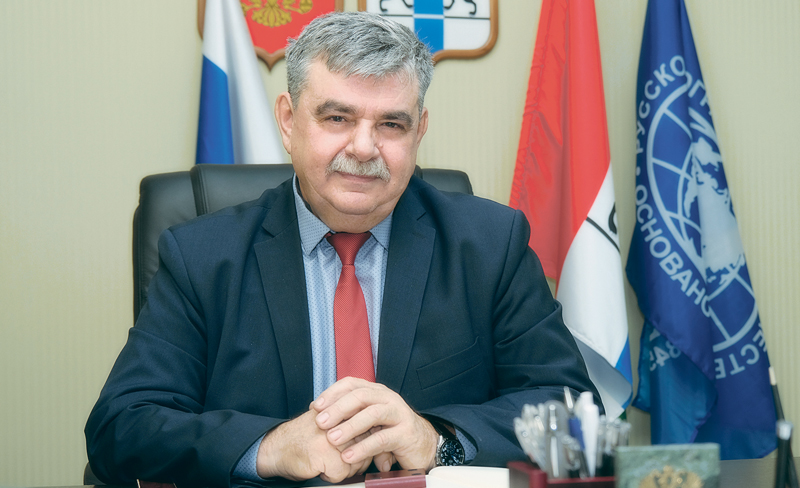
Sergei Lysenko, director of the Siberian Geophysical College
Recordings of these recruitment meetings have also surfaced in regional media. The Telegram channel Incident Kuzbass, for example, published an audio recording in which “Oksana B. F.,” a teacher at Anzhero-Sudzhensk Polytechnic College, urges students to sign a “drone forces” contract. The college employs a teacher named Oksana Borisovna Fedorova, listed in the institution’s staff roster as an instructor of “Fundamentals of Security and Defense of the Motherland.”
“There will be a decisive meeting where we’ll send you off to the army. The draft is just starting. If you don’t take academic leave, we’ll expel you for failing grades, and that’s how you’ll get taken. We’ll report you to the draft office right away <…> He’ll get his summons the very next day, believe me. And he’ll sign the contract there — mark my words, there is an eighty percent chance”
“Oksana B. F.” offered students an alternative to a regular contract — joining the “drone forces” and supposedly serving outside the combat zone:
“You won’t really have a choice here: it’s either the drone forces, or a regular contract — straight to the front line as cannon meat.”
In February 2026, Groza readers reported that students at a college affiliated with Kazan Innovative University were called to a meeting without explanation, where the college director, Yulia Khadiullina, announced that they had “already all been expelled.” At the meeting, a representative from the draft office offered the “expelled” students a contract to take part in the “special operation,” with the promise of reinstatement afterward.
At the meeting, Khadiullina told the students that their “limit of trust had run out,” and that they would all be expelled — but not before the “draft officers” addressed them.
“We’re going to talk about the fact that our country is currently in a special military operation. Right now the country needs warriors. Boys who are 18 are eligible. So the new army will be formed from those students who can no longer be considered students — that’s you,” Khadiullina told students at the meeting.
Khadiullina also said students needed to “listen carefully” to the terms the “draft officers” would explain, because they “could no longer stay” at the college, and the college “could no longer hide” from the draft office the lists of people who “don’t attend classes and are completely failing to keep up with the curriculum.”
“Every one of you spat on everything we warned you about. And I don’t feel the least bit sorry that each of you is going to be expelled. But every one of you still has options. The country believes in you.”
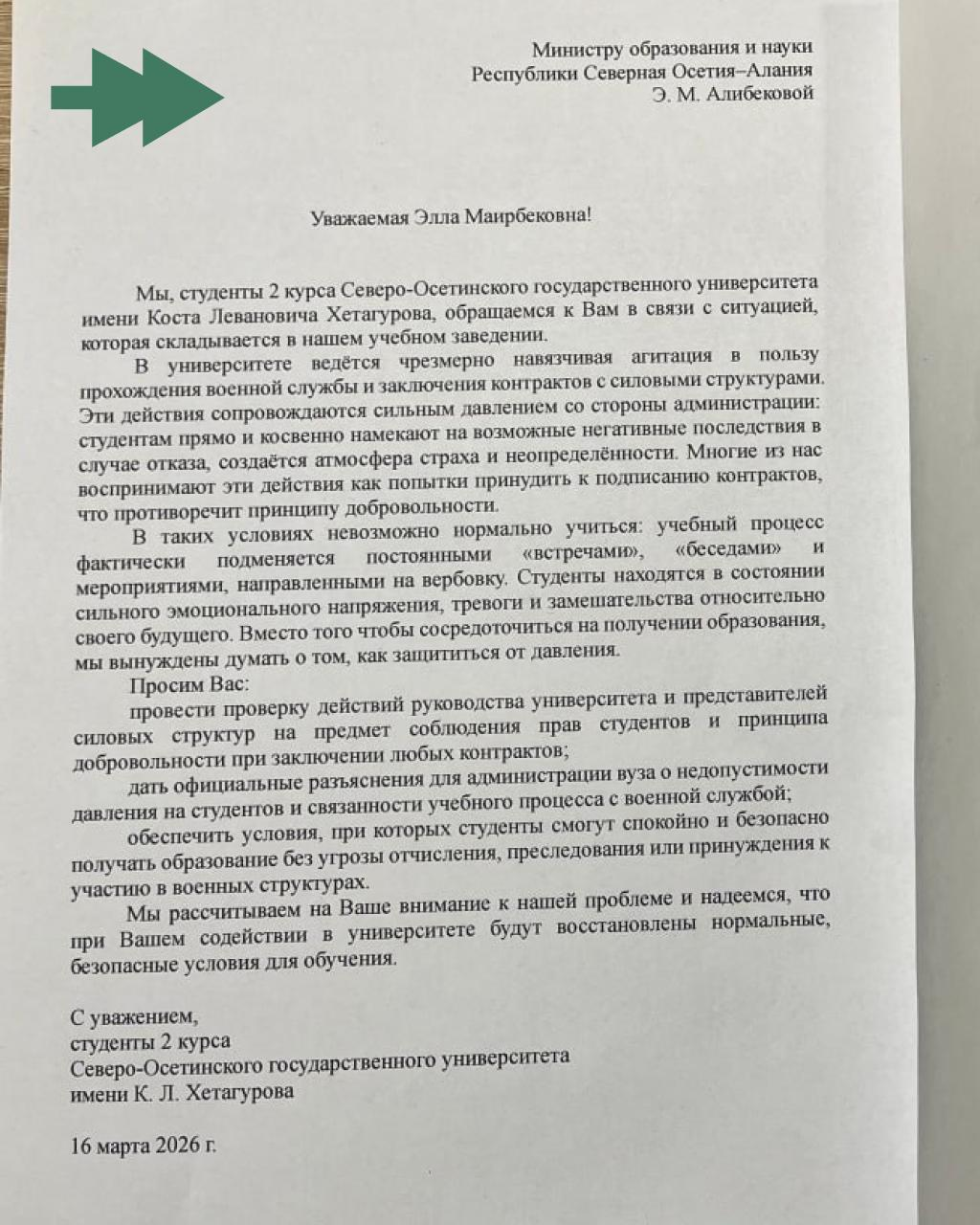
In March 2026, second-year students at North Ossetian State University (NOSU) drafted a petition to North Ossetia’s minister of education and science, complaining of “excessive, intrusive campaigning” for the drone forces at the university.
They also mentioned the “negative consequences” they’d been promised if they refused to sign a contract. The students asked the republic’s education minister to “ensure conditions in which students can pursue their education calmly and safely, without the threat of expulsion, harassment, or coercion into military structures.”
“Students are in a state of severe emotional strain, anxiety, and confusion about their future. Instead of focusing on our education, we’re forced to think about how to protect ourselves from this pressure,” the student wrote in their petition.
Two weeks after the petition was reported in the media, NOSU rector Alan Ogoev held a meeting with students and commented on it:
“Frankly, I’m deeply outraged by this so-called petition about coercive recruitment at our university. Do you even understand what a university is? It’s not a stage for cheap publicity stunts and teenage rebellion.”
Iskander Galeev, director of the Institute of Physical Culture at the Volga Region State University of Physical Culture, Sport and Tourism, met with the institute’s students to talk up the “advantages” of a Defense Ministry contract — Groza readers reported on the meeting in April 2026.
During his talk, Galeev claimed the Defense Ministry was appealing “primarily to students” because “the country needs their help and support.” He also told students that Russia was fighting for its “survival” not against Ukraine, but against the entire “capitalist world” — NATO, the European Union, and America. In Galeev’s view, the war is being fought so that “we can all sit quietly, calmly, comfortably, in a warm room — study, live, sleep, eat, love.”
Galeev denied that he was “campaigning” among students — he said he was simply “informing” them. According to Groza readers, students were required to sign to confirm their attendance at the meeting, and those who arrived late were offered “honorary free seats in the front row” by Galeev.
Artyom Klyga, a human rights advocate and head of the legal department at the Movement for Conscientious Objection, reported in February 2026 that class monitors at one of the Plekhanov Russian University of Economics’ schools were told: “Every month, our School is required to send two willing students to sign contracts with the drone forces for the Special Military Operation.”
At the same time, Groza readers from Plekhanov University said that class monitors at the university’s other schools had not been told about such a requirement.
At Voronezh State University of Engineering Technologies, Aleksei Skrypnikov, dean of the Faculty of Control and Information Technologies in Technological Systems, pressed students at a meeting to sign contracts — while accusing them of the fact that half of them “don’t study properly, you’re hustling, you’re working.” He also urged the young men to “imagine” their “girlfriends” “being raped by fascists” and their mothers “being abused,” according to Verstka.
“Raise your hand if you consider yourself a man. Are there any men in this room? No? I’m ashamed of you! Take off your trousers, put on skirts, and tie on some little bows! What did your mothers raise — weaklings? Or are you actually future fathers? Or are we just going to surrender, say ‘Khokhols [a derogatory term for Ukrainians], we give up’? How exactly do you picture that?” Skrypnikov said.
Maria Kirsanova, director of the Lunin Novosibirsk College of Transport Technologies, accused students of lacking “patriotism,” of wanting to “dodge the army,” and of being afraid for their own lives, in a conversation about serving in the drone forces — because no one at the college wanted to drop out and go to war. Kirsanova also noted that she herself would go to war, but isn’t accepted because of her age.
“Guys, come on, the Motherland is asking. And the answer is, ‘oh, so we’ll come back in a zinc coffin?’ Where does this fear come from? Who put this fear in your heads? And who’s going to defend us? I’m telling you — go now, you’ll get your diploma. No need to wait around studying until June — sign the contract now,” Kirsanova said.
“Military officers had spoken to us before, offering contracts as drone operators. Probably because there wasn’t much response, they gathered the upperclassmen, and our director gave us an ‘educational talk.’ I was there,” said the college student who shared the recording with journalists.
“We have neither the intention nor the means to force students to take part in the SMO,” the Defense Ministry said in April 2026, commenting on reports that universities were pressuring students into signing drone-forces contracts.
That same month, Deputy Education Minister Dmitry Afanasyev said the ministry had received only six complaints from students or their parents, alleging that universities were expelling and pressuring students to push them into the drone forces — but claimed “not a single case was confirmed.”
Meanwhile, recruiters keep finding new ways to get young people to sign. Where once they were only interested in adult men, girls are now being recruited for the drone forces too, and minors are being asked to sign statements committing to sign a contract once they turn 18.
At Ufa State Petroleum Technological University, students were also asked to bring in friends and acquaintances to sign Defense Ministry contracts through the university — in exchange, the university promised to help those friends get jobs or enroll as students there.
There is no such thing as a special contract guaranteeing service in the unmanned systems forces and a guaranteed return after a year, human rights advocates say.
In February, a college in Ulyanovsk published the addendum to the contract offered to students for drone-forces service, which states they can be reassigned to other branches. This is a standard form used across all universities and colleges, according to human rights advocate Artyom Klyga. What’s more, commanders are under no obligation to discharge drone-forces contract soldiers after a year, as confirmed by the response from the acting head of the unmanned systems forces.
At least three students are now known to have been killed in the war against Ukraine after signing drone-forces contracts.
According to the BBC, 23-year-old Valery Averin from Buryatia signed a contract with the Defense Ministry on January 3, 2026, following a drone-forces recruitment drive at his college — the Buryat Republican Technical School of Construction and Industrial Technologies. He trained as a drone operator and was killed on April 6 in an assault near Luhansk — just three months after starting his service.
In June, media also reported the death of Ilya Ulyanov, born in 2006, who signed a contract in his final year at an agro-industrial technical school on May 23, 2025. His obituary stated that Ulyanov served as a “drone operator with the communications battalion of Guards military unit 69647” and was killed on May 27, 2026, “while carrying out a combat mission near the village of Sladkoye in Zaporizhzhia region.” The circumstances of his death were not specified.
The third student recruited into the drone forces whose death in the war against Ukraine was reported by independent media is Vladislav Gorbunov, from Bryansk region. He was 18 and signed a contract with the Defense Ministry in December 2025. In an interview with the regional branch of the Movement of the First, Gorbunov himself said that after three months of drone-operator training he was sent to assault units, and only later transferred to work with drones. He was killed on April 6 “while carrying out a combat mission”; his relatives have not publicly disclosed the circumstances of his death.